
Search

nano-home Home Water Filter Kit

Delivery time: 2–4 business days

Including VAT

Free shipping within Germany, Austria, and Switzerland. Shipping to other EU countries is always subject to a fee.

180-day money-back guarantee on all products (excluding installation and removal costs)

Up to a 20-year manufacturer's warranty

Maintenance interval: Filter replacement annually (nano-home) or every 2 years (protect-home)

Would you like us to help you choose?

Would you like us to help you choose?

An Overview of Our Home Water Filters

An Overview of Our Home Water Filters

The household water filter cartridges can be replaced annually as needed. Depending on your needs, you can choose from the three available filter types (cartridges) and adapt your system to your current water requirements at any time.

The household water filter cartridges can be replaced annually as needed. Depending on your needs, you can choose from the three available filter types (cartridges) and adapt your system to your current water requirements at any time.

protect-home

protect-home

Up to 80% limescale protection for the softest water throughout the home using seed crystal technology.

  • Patented descaling technology
  • Certified limescale protection rate of up to 80%
  • Verified protection for water heaters and pipes
  • No use of environmentally harmful salts

Up to 80% limescale protection for the softest water throughout the home using seed crystal technology.

  • Patented descaling technology
  • Certified limescale protection rate of up to 80%
  • Verified protection for water heaters and pipes
  • No use of environmentally harmful salts
Seed Crystal Technology

nano-home

nano-home

Pure nanofiltration to remove contaminants without limescale protection

  • Bacteria & Viruses
  • Heavy Metals
  • Drug residues
  • Microplastics
  • Pesticides
  • PFAS & TFA
  • Chlorine

Pure nanofiltration to remove contaminants without limescale protection

  • Bacteria & Viruses
  • Heavy Metals
  • Drug residues
  • Microplastics
  • Pesticides
  • PFAS & TFA
  • Chlorine
Primary Filtration

Tested by RTL

Tested by RTL

protect-home in an independent RTL comparison.

protect-home in an independent RTL comparison.

Stainless Steel vs. Plastic

Stainless Steel vs. Plastic

Stainless steel housing:
High-quality stainless steel ensures maximum durability, stability, and hygiene, backed by a 20-year manufacturer’s warranty. Ideal for professional use with an elegant appearance.

Plastic housing:
Lightweight, durable, and easy to clean, with a 5-year manufacturer’s warranty. A flexible and cost-effective solution for versatile use in homes and businesses.


One Housing – 3 Options:
All cartridge types are fully compatible with the selected housing. The cartridge can be swapped out as desired for limescale protection, contaminant filtration, or the smart combination solution.

Stainless steel housing:
High-quality stainless steel ensures maximum durability, stability, and hygiene, backed by a 20-year manufacturer’s warranty. Ideal for professional use with an elegant appearance.

Plastic housing:
Lightweight, durable, and easy to clean, with a 5-year manufacturer’s warranty. A flexible and cost-effective solution for versatile use in homes and businesses.


One Housing – 3 Options:
All cartridge types are fully compatible with the selected housing. The cartridge can be swapped out as desired for limescale protection, contaminant filtration, or the smart combination solution.

Our Core Technologies for Residential Water Treatment

Seed Crystal Technology

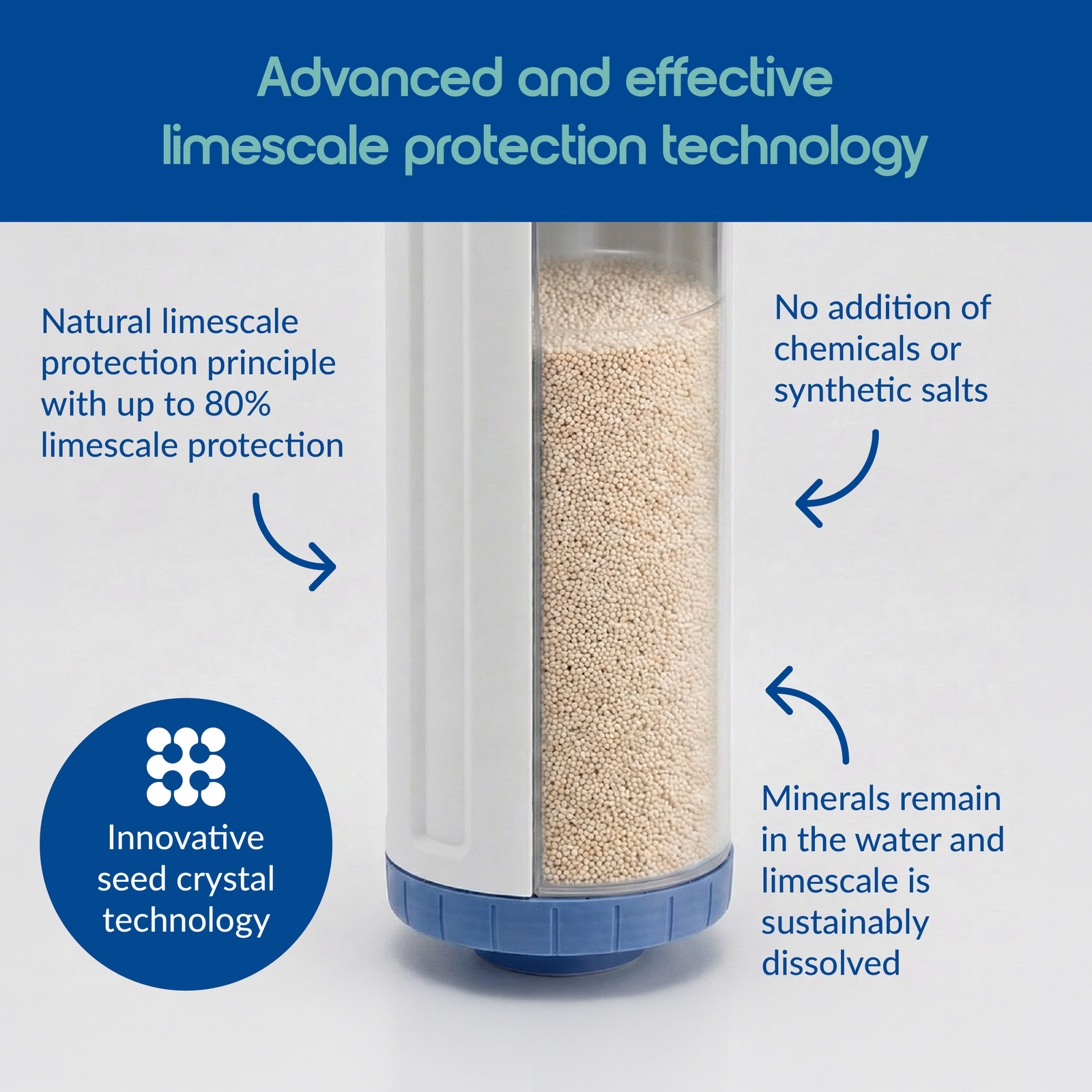
Seed crystals are a physical principle in water treatment that is specifically used to control scale formation. In this process, dissolved minerals such as calcium and magnesium first deposit on the surface of the seed crystals, where they form stable crystal structures.
These structures continue to grow in the water, subsequently detaching from the seed crystals and remaining in the water in a form that deposits on surfaces significantly less than limescale.

The natural minerals remain in the water, while pipes, faucets, and appliances are better protected against deposits. This preserves the original water quality while reducing limescale problems in the home.
Seed crystal technology operates without chemicals or synthetic salts and requires no electricity or wastewater. In the dropvital product line, it is used in the “protect-home” system and offers a sustainable, low-maintenance solution for limescale protection throughout the home.

Seed Crystal Technology

Seed crystals are a physical principle in water treatment that is specifically used to control scale formation. In this process, dissolved minerals such as calcium and magnesium first deposit on the surface of the seed crystals, where they form stable crystal structures.
These structures continue to grow in the water, subsequently detaching from the seed crystals and remaining in the water in a form that deposits on surfaces significantly less than limescale.

The natural minerals remain in the water, while pipes, faucets, and appliances are better protected against deposits. This preserves the original water quality while reducing limescale problems in the home.
Seed crystal technology operates without chemicals or synthetic salts and requires no electricity or wastewater. In the dropvital product line, it is used in the “protect-home” system and offers a sustainable, low-maintenance solution for limescale protection throughout the home.

The process explained in 4 steps:

The process explained in 4 steps:

Contact with the catalyst granules

Inside the cartridge is a specially developed granulate with a surface that provides binding sites for calcium and carbonate ions dissolved in the water.

Formation of Vaccination Crystals

At these attachment sites, microscopic calcium carbonate crystals—known as seed crystals—form without the use of chemicals, electricity, or other additives.

Discharge into the sewer system

Once the vaccine crystals have reached a certain size, they detach from the granules and are released into your plumbing system along with the water.

Protection of the Entire Installation

In the plumbing system, the vaccine crystals bind excess lime. The lime tends to deposit on the crystals rather than on your home’s plumbing fixtures. The crystals are flushed out every time water is drawn.

Nanofiltration

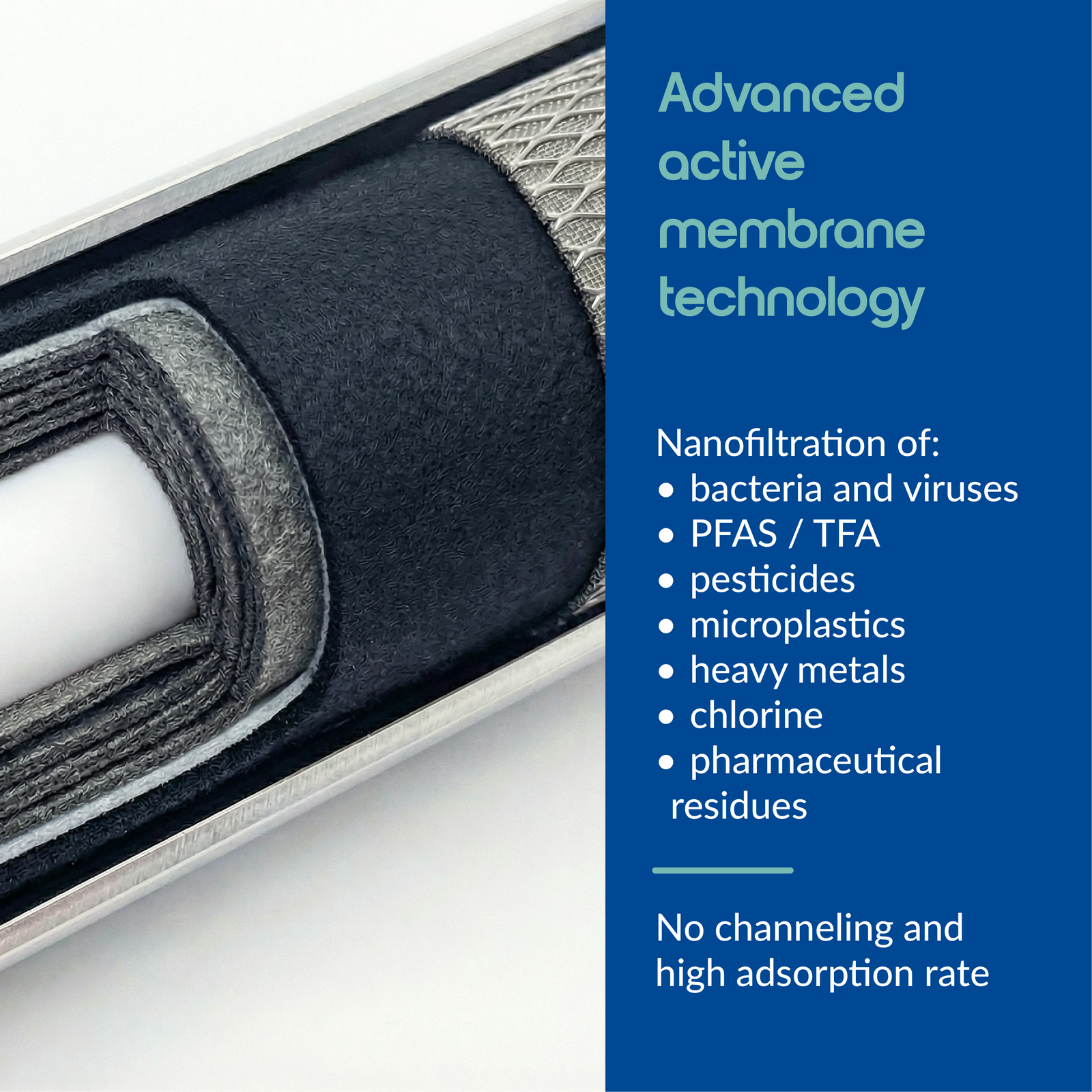
The unique nanofiltration system we have developed specifically removes contaminants and impurities from household water and is effective down to the finest levels. The active membrane achieves up to 99% contaminant removal at a filtration depth of 0.002 micrometers. This enables nanofiltration to provide excellent deep filtration in the lowest nanoscale range, even at constant and high water flow rates.

Nanofiltration

The unique nanofiltration system we have developed specifically removes contaminants and impurities from household water and is effective down to the finest levels. The active membrane achieves up to 99% contaminant removal at a filtration depth of 0.002 micrometers. This enables nanofiltration to provide excellent deep filtration in the lowest nanoscale range, even at constant and high water flow rates.

Combining the best of both worlds

Combining the best of both worlds

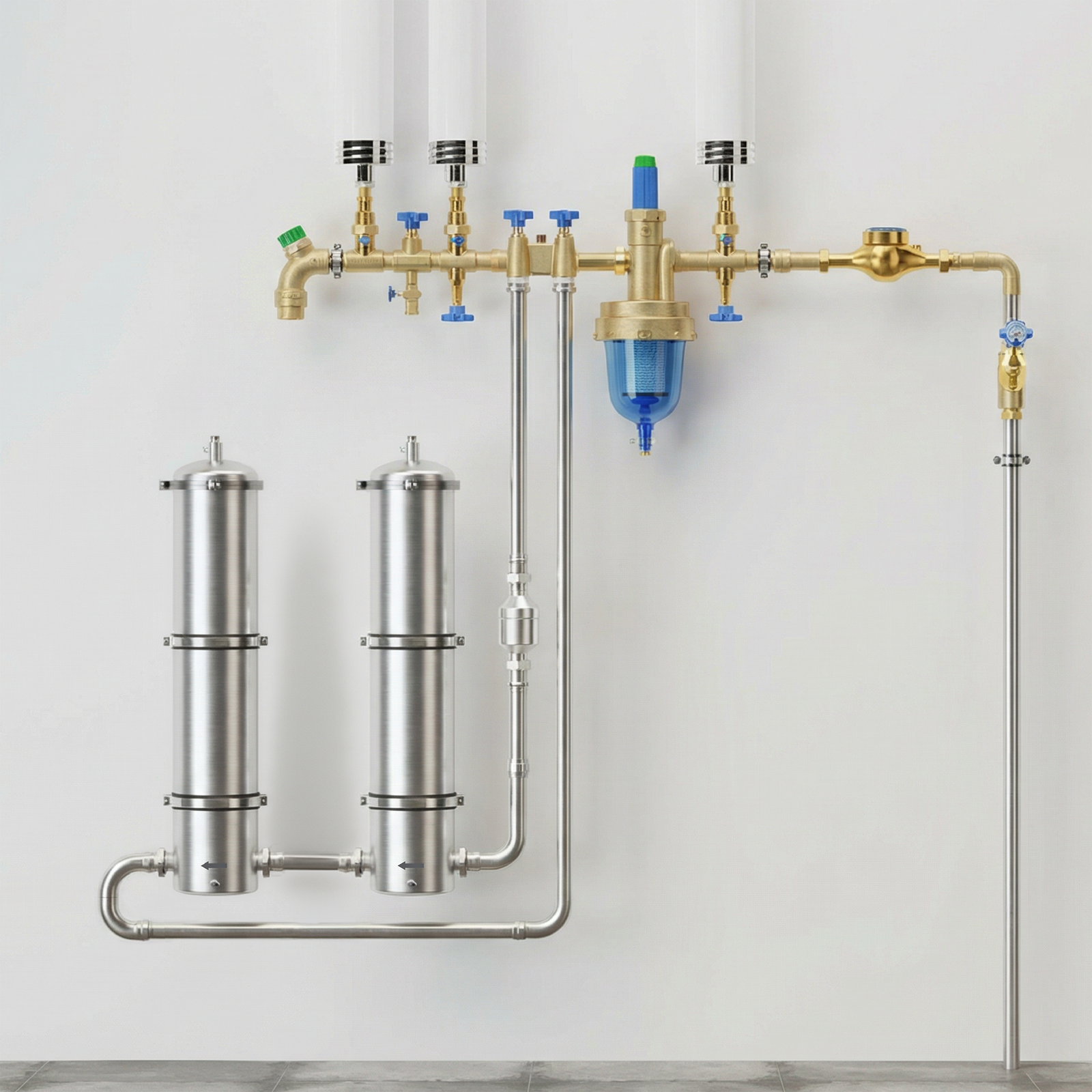
For comprehensive protection of your household water, the nano-home and protect-home can be easily installed in series, one after the other.

The water first passes through the nano-home cartridge, which removes contaminants such as bacteria, heavy metals, microplastics, PFAS, TFA, and many others down to 0.002 micrometers. The water then flows through the protect-home cartridge, where natural seed crystals are formed that bind excess lime and protect your pipes.


Ideal for anyone who doesn’t want to compromise on water quality or limescale protection.

For comprehensive protection of your household water, the nano-home and protect-home can be easily installed in series, one after the other.

The water first passes through the nano-home cartridge, which removes contaminants such as bacteria, heavy metals, microplastics, PFAS, TFA, and many others down to 0.002 micrometers. The water then flows through the protect-home cartridge, where natural seed crystals are formed that bind excess lime and protect your pipes.


Ideal for anyone who doesn’t want to compromise on water quality or limescale protection.

Treat yourself

Treat yourself

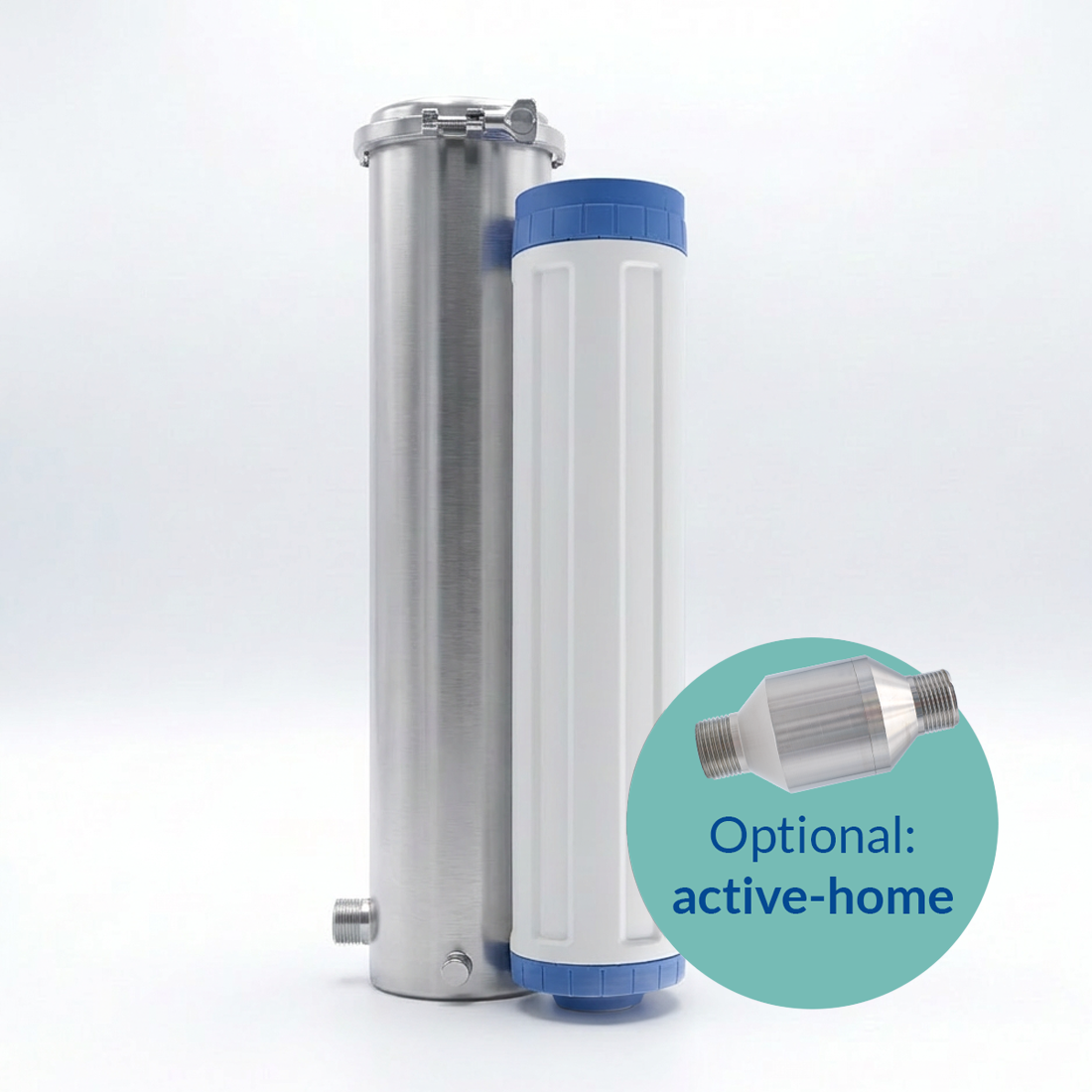
Upon request, the home water system can be supplemented with the active-home water enhancer. The patented rotational process promotes a high oxygen content in the water, harmonizes its structure, and ensures a noticeably gentler and more soothing water experience throughout the home.

Upon request, the home water system can be supplemented with the active-home water enhancer. The patented rotational process promotes a high oxygen content in the water, harmonizes its structure, and ensures a noticeably gentler and more soothing water experience throughout the home.

More oxygen
Fresh Taste
Completely maintenance-free
Patented Process

What's Included

What's Included

Included in the set:

  • Housing (stainless steel or plastic, depending on your choice)
  • Selected filter cartridge (protect-home / nano-home)
  • 2x vent valves (only with the stainless steel housing)
  • Rubber drain hose(only with stainless steel housing)
  • Maintenance hook
  • Installation and Maintenance Instructions

Included in the set:

  • Housing (stainless steel or plastic, depending on your choice)
  • Selected filter cartridge (protect-home / nano-home)
  • 2x vent valves (only with the stainless steel housing)
  • Rubber drain hose(only with stainless steel housing)
  • Maintenance hook
  • Installation and Maintenance Instructions

Don't want to install it yourself?

Don't want to install it yourself?

No problem. Our experienced team of certified installers will handle the professional installation right in your home. That way, your system will be up and running in no time, and you can sit back and relax.

No problem. Our experienced team of certified installers will handle the professional installation right in your home. That way, your system will be up and running in no time, and you can sit back and relax.

Frequently Asked Questions

General Questions

No. Installing dropvital’s domestic water systems requires technical expertise, such as that possessed by a licensed plumber. During installation, factors such as water pressure, pipe routing, and the installation diagram must be properly taken into account.

Therefore, we recommend always having the soft-home installed by a qualified professional. This ensures a safe installation and proper commissioning, and you will receive hands-on instruction from the installer.

Domestic water systems may only be installed directly on the pressure-reduced cold water line at the main domestic water supply line.

It is important to follow a specific installation sequence:

The domestic water systems are installed after the water meter, the pressure reducer, and any existing sediment or backwash filter.

This ensures that all domestic water is treated under stable conditions.

No. active-home is an optional add-on to dropvital’s home water systems and has no effect on the quality of the limescale protection itself.

In active-home, the water is subjected to intense circulation at approximately 100,000 revolutions per minute by means of a patented rotating nozzle. This rotational movement creates a cluster of aligned water molecules, described in technical literature as a coherence domain. As a result, the water takes on a structured, hexagonal arrangement, also known as H3O2.

This physical agitation increases the water’s internal surface area. As a result, the water exhibits altered conductivity and solubility characteristics and displays a pronounced dynamic structure.

An additional benefit is the sensory change in the water following the treatment. Many users describe the taste as lighter and fresher. Furthermore, the movement allows the water to mix more effectively with the ambient air after it exits the system.

The active-home is maintenance-free and comes with a 20-year warranty. As an optional upgrade, it is an interesting addition for users who value additional physical water treatment.

No. The domestic water systems operate purely on physical principles using catalyst granules and require neither electricity nor a sewer connection. No regeneration or rinse water is produced.

This makes installation particularly flexible and cost-effective, since no electrical supply or sewer connection is required at the installation site.

Yes. For comprehensive protection of your household water, protect-home and nano-home can be installed in series, one after the other. This allows you to combine natural limescale protection through seed crystals with highly effective nanofiltration against contaminants in a single solution.

Recommended installation order:

  1. nano-home (contaminant filtration) – after the pressure-reducing valve and sediment filter
  2. protect-home (scale protection) – immediately after the nano-home

Both cartridges operate independently of one another and can also be replaced individually. Different replacement intervals apply: The nano-home is replaced annually, while the protect-home does not need to be replaced until after 2 years.

Yes. The systems can be scaled freely and used for properties of any size.

For larger properties or apartment buildings, we offer personalized consultations to find the right solution for your needs. Please feel free to contact us for a no-obligation consultation.

protect-home

The protect-home cartridge operates on the principle of seed crystallization—a purely physical process that has its origins in nature. It is based on the process of biomineralization, as seen, for example, in the formation of mussel shells or coral.

Inside the cartridge is a specially developed catalyst granulate. Its surface provides specific binding sites for the calcium and carbonate ions dissolved in the water. At these sites, microscopic calcium crystals—known as seed crystals—form without the use of chemicals, electricity, or any other additives.

As soon as these seed crystals reach a certain size (a few hundredths of a millimeter), they detach from the granules and are released into your plumbing system along with the water flow. This frees up the binding sites on the granules, and the process starts over—continuously and without depleting the granules.

Within the plumbing system, the seed crystals bind excess calcium. This calcium tends to deposit on the crystals—rather than on your pipes, water heaters, heat exchangers, or faucets. Every time water is drawn, the loaded crystals are flushed out through the taps.

Important:
No substances are added to or removed from the water. The water’s composition remains completely intact—including the valuable minerals calcium and magnesium. The protect-home operates without salt, without electricity, and without a wastewater connection.

According to independent tests conducted in accordance with DVGW Worksheet W510, devices that operate on the principle of heterogeneous catalysis (seed crystallization) achieve at least 80% protection against limescale. The process has been proven over many years and is used by renowned manufacturers in the water treatment industry.

This effectiveness refers to the protection of the drinking water system—that is, pipes, water heaters, heat exchangers, and faucets. Scale deposits in these areas are largely prevented at temperatures up to 80 °C.

Important note:
Since the hardness minerals remain in the water, the formation of limescale stains on visible surfaces such as faucets, glass shower walls, or tiles cannot be completely prevented. However, these deposits are significantly less extensive and can be removed much more easily than without limescale protection.

Yes. The seed crystal technology used in protect-home is based on the scientifically established principle of heterogeneous catalysis, also known as biomineralization. This process has been the subject of technical testing for many years and is used by several renowned manufacturers in the water treatment industry.

Testing and Certification According to DVGW

The effectiveness of scale prevention devices based on seed crystallization is tested in accordance with DVGW Worksheet W510 (Requirements for Devices for the Treatment of Drinking Water in Domestic Plumbing Systems) and DVGW Worksheet W512 (Procedures for Assessing the Effectiveness of Water Treatment Systems for Reducing Scale Formation).

Key results from independent tests of comparable methods:

  • Scale prevention effectiveness of at least 80%, proven under standardized laboratory conditions
  • Effectiveness at water temperatures up to 80 °C in drinking water systems
  • No change in the composition of drinking water
  • No use of treatment chemicals as defined by the Drinking Water Ordinance
  • Passed hygiene and safety tests as part of the type testing

Normative Basis

Since 2024, DIN 3607 has served as a dedicated standard for limescale prevention devices, covering, among other things, devices based on heterogeneous catalysis. This standard defines requirements for effectiveness, hygiene, and operational safety and forms the current regulatory framework for the German market.

Scientific Background of the Process

The process of biomineralization is one that has occurred in nature for millions of years. The formation of calcareous skeletons in mussels, snails, and corals, as well as the formation of tooth enamel and bones, are based on the same fundamental principle: the targeted formation of calcium carbonate crystals from dissolved ions on catalytic surfaces.

The scientific application of this principle to technical water treatment (bionics) has yielded results that are recognized by both the scientific community and testing institutes. The catalyst granules used mimic the natural process and are capable of selectively forming minute calcium carbonate crystals from the calcium and carbonate ions dissolved in the water.

Additional Certifications and Quality Seals

Depending on the unit model, systems based on seed crystal technology have the following certifications:

  • DVGW type-test certificate according to worksheet W510 (Germany)
  • SVGW certification (Switzerland)
  • ÖVGW Water Quality Seal (Austria)
  • Compliance with the Drinking Water Ordinance—no use of treatment chemicals

Context within dropvital

Dropvital uses seed crystal technology in the protect-home exclusively as part of a physical water treatment process. The tests and certifications listed above demonstrate the technical effectiveness and regulatory compliance of the process. No health- or medical-related claims are made regarding the treated water.

Summary

Seed crystal technology is a scientifically sound, normatively regulated, and independently certified process for preventing scale buildup in drinking water systems. Its effectiveness has been tested and confirmed in accordance with DVGW W510/W512 and DIN 3607.

The measured water hardness remains unchanged with the protect-home—and that is by design.

To understand this, it’s important to know what a hardness measurement actually measures: Conventional test strips and standard hardness testing methods detect only the total amount of calcium and magnesium ions in the water. In other words, they measure the mineral content—nothing more, nothing less. A simple hardness measurement does not distinguish whether these minerals are freely available, whether they are bound to crystals, or whether they can actually precipitate as limescale.

This is precisely the crucial point.

What happens with a salt-based system:
Conventional water softeners physically remove calcium and magnesium from the water and replace them with sodium. The hardness test then shows a lower value because the minerals are, in fact, no longer present. The result: The water lacks valuable minerals, and the sodium content rises.

What happens with protect-home:
Seed crystal technology does not remove the minerals from the water but alters their behavior. Calcium and carbonate ions are bound to the microscopic seed crystals. In this bound form, they can no longer settle as limescale on pipes, water heaters, or faucets. Limescale protection is thus active—yet the minerals remain present in the water.

Since the hardness measurement only records the total amount of minerals and not their physical state, it continues to indicate the original hardness level. This is not a flaw in the system, but rather the logical result of a process that deliberately leaves the minerals in the water.

Why this is an advantage:

Calcium and magnesium are essential minerals for the human body. Among other things, they contribute to the development of bones and teeth and play a role in numerous metabolic processes. Furthermore, they also enhance flavor—minerals give drinking water its natural, fresh taste.

Because the protect-home leaves these minerals entirely in the water, you benefit simultaneously from effective limescale protection in your plumbing system and from drinking water that retains its natural composition. No sodium is added, the water is not mixed with raw water, and the water chemistry remains unchanged.

In summary:

The water hardness reading remains the same because the minerals are retained. Nevertheless, limescale protection is ensured because the limescale deposits onto the seed crystals instead of your plumbing system. What matters is not the numerical value on the test strip, but the behavior of the minerals in the water—and this is precisely what the seed crystal technology specifically alters.

No. The protect-home does not alter either the composition or the pH level of your drinking water.

The seed crystallization process is purely physical. No chemicals are added, and no minerals are removed. The pH level, conductivity, and hardness of the water remain completely unchanged.

The valuable minerals calcium and magnesium remain in the water. The treated water is safe to drink—even for pregnant women, infants, children, and people who should or choose to follow a low-sodium diet.

Yes. Over a period of several weeks to months, existing lime scale deposits in your pipes can be gently dissolved. The seed crystals dispersed in the water shift the lime-carbonic acid balance in such a way that existing deposits are gradually removed.

This process is gentle and does not involve any aggressive chemical treatments. It is therefore possible that, in the initial phase following installation, isolated dissolved lime particles may become visible at water outlets. This is a normal part of the cleaning process and does not indicate a system defect.

In salt-based water softening systems, the treated water is intentionally mixed with untreated raw water. The reason: During ion exchange, calcium and magnesium ions are replaced by sodium ions. Complete softening would raise the sodium content in drinking water to an unacceptable level. Therefore, salt-based systems must always have a portion of untreated water mixed in to limit the sodium content. In practice, this means that not all of the household water is treated uniformly.

With protect-home, the situation is fundamentally different.

Seed crystal technology adds no sodium or other substances to the water. The water’s composition remains completely unchanged. There is therefore no reason to mix the treated water with raw water.

The bypass is set so that 100% of the water flows through the protect-home cartridge.

The advantage:

All household water is treated uniformly—at every faucet, consistently, and without variations in water quality. There are no bypass flows, no mixing, and no dilution effect.

Furthermore, since the protect-home does not have a regeneration cycle, there are no phases during which untreated water enters the home. Limescale protection is active continuously and without interruption—without electricity, without wastewater, and without salt.

It is important to understand that while the salt used in salt-based water softeners is originally a natural product, it is chemically processed and denatured for technical use.

Commercially available regeneration salt consists of at least 94% sodium chloride (NaCl). For use in water softeners, this salt is specifically treated to make it undrinkable. In addition to natural impurities such as clay and calcium or magnesium sulfates, anti-caking agents—often iron or potassium hexacyanoferrate—are typically added to the salt to prevent clumping and ensure proper technical function.

Accordingly, regenerant salt is not table salt, sea salt, or Himalayan salt, but rather a technical salt that is expressly not intended for human consumption.

This is also made clear by the hazard and safety warnings required on the packaging, including:

  • H412 – Harmful to aquatic life with long-lasting effects
  • P102 – Keep out of reach of children
  • P315 / P101 – Seek medical advice and keep the label handy
  • P410 – Protect from sunlight

These labels refer to the water softener salt itself and are part of its classification under chemical regulations. They make it clear that this is a technical operating material used in water softening systems, and that its handling and disposal are regulated.

Additionally, it should be noted that salt-based water softening systems produce salt-containing regeneration wastewater, which enters the sewer system and can contribute to increased salt and chloride levels there. These very effects have been the subject of environmental studies for years.

Brief

Summary: The regeneration salt used in salt-based water softening systems is not a food product but a chemically treated technical operating material with clear hazard labeling. In addition to technical side effects, its use also entails environmental implications—a key difference from salt-free limescale prevention systems such as dropvital.

https://www.bmluk.gv.at/dam/jcr:250fe6a2-18af-4b2a-99bb-a25d6ff87f3d/Chlorid%20Studie.pdf

https://blog.uni-koblenz-landau.de/gewaesserversalzung-gefahr-fuer-mensch-und-umwelt/

https://www.quarks.de/umwelt/drei-gruende-warum-du-besser-auf-streusalz-verzichtest/

https://www.bund-sh.de/stadtnatur/winterdienst/

In the U.S., there is no uniform nationwide regulation against salt-based water softening systems, but several states, regions, and municipalities have enacted strict restrictions or bans—primarily for environmental and water management reasons.

1. Salt-containing wastewater (brine) and environmental impact

Salt-based water softeners operate via ion exchange and produce salt-containing wastewater (brine) during each regeneration cycle, which enters the sewer system and from there flows into natural water bodies and groundwater. This brine contains high concentrations of chloride and sodium, which can accumulate in water bodies.

  • In regions with sensitive freshwater ecosystems, elevated salinity can impair the living conditions for aquatic organisms and plants.

2. Complications in wastewater treatment and reuse

Many municipalities have programs in place for the reuse of municipal wastewater, for example, for irrigation or groundwater recharge. Saline wastewater poses a problem for such systems because existing wastewater treatment plants cannot remove enough salt.

As a result, water that is intended for reuse is no longer suitable for these purposes or requires costly additional treatment.

3. Local Regulations and Legal Framework

Based on these environmental and water quality concerns, various authorities have enacted legal frameworks and regulations governing the use of traditional, salt-based water softening systems:

  • In Texas, a statewide ban on salt-based water softeners was introduced as early as 2001; subsequent amendments now permit their use only under certain conditions.
  • In California, regional water agencies may, under the California Water Code, impose local bans or restrictions on such systems, particularly in regions that do not meet salt/chloride load limits.
  • Other states, such as Connecticut, Michigan, Minnesota, and Wisconsin, have similar restrictions, some of which are linked to bans on discharging brine into wastewater treatment systems or programs promoting salt-free technologies.

In some local communities, water softeners have even been completely banned, and systems that were already installed have been dismantled; inspections and enforcement measures are actively carried out in some areas.

4. Increased Regulatory Oversight in Response to Studies and Practical Impacts

Studies have shown that rising salt and chloride concentrations in water bodies and wastewater systems cause serious ecological and technical problems:

  • Aquatic species are sensitive to saline water; studies indicate negative effects even at relatively low salt concentrations.
  • Costs and operational burdens for wastewater treatment plants and infrastructure are increasing because salt cannot be easily removed.

Conclusion

The restrictions and bans on salt-based water softeners in parts of the U.S. are not based on health concerns or medical arguments, but rather on water management, environmental, and wastewater treatment considerations:

  • Brine discharge pollutes water bodies and ecosystems.
  • Salt-contaminated wastewater hinders water reuse and treatment processes.
  • Regulatory agencies have exercised local authority to restrict or ban these systems in order to meet environmental goals and water quality standards.

In the affected regions, there is therefore a growing reliance on salt-free technologies or alternative water treatment concepts to avoid the environmental impact of saline wastewater.

Sources: 

https://www.solucionesice.com/de/gibt-es-ein-verbot-fuer-salzwasserenthaerter/?utm

https://www.lifesourcewater.com/blog/water-softeners-banned-by-law.php?utm

https://aquasureusa.com/blogs/water-guide/water-softener-ban?srsltid=AfmBOorif1GjsmkIUOxfOi73MbKaLLGhD8MZGjWlfJ8lIYpk7uHxcIo7&utm;

https://hydroflow-usa.com/blog/commercial-blogs/why-are-water-softeners-being-banned/?utm

The protect-home requires very little maintenance. The cartridge must be replaced every 2 years.

Compared to other limescale protection systems that require annual cartridge replacements, regular salt refills, or ongoing service contracts, the maintenance required for the protect-home is minimal.

Replacing the cartridge costs CHF 399. Upon request, maintenance can be performed by one of our service technicians. The service call costs an additional CHF 200.

There are no other ongoing costs—no electricity, no wastewater, and no hidden service fees.

The housing is covered by a manufacturer’s warranty of up to 20 years (stainless steel) or 5 years (plastic).

nano-home

In general, it’s important to understand: If a manufacturer claims, for example, that it filters out pesticides, then this statement is theoretically correct—depending on the pore size of the filter. For traditional activated carbon filters, this is typically a maximum of 0.1 micrometer.

Contaminants with particle sizes smaller than this pore size cannot be physically retained. In practice, this means that not all dissolved substances are effectively removed. Many suppliers remain vague on this point and do not publish specific information about pore size. Insist on transparent evidence.

Conventional activated carbon filters operate in the range of about 0.1 micrometer.

Dropvital, on the other hand, has demonstrated in independent laboratory tests conducted by the international testing institute SGS that the nano-home achieves effective filtration down to 0.002 micrometers.

The key difference lies in the structure of the filter material. With nano-home, the design ensures that retained substances are not released back into the water. With traditional activated carbon filters, channeling can occur in the filter bed over time, causing filter performance to decline.

Nano-home is designed to last up to 12 months and should be replaced annually.

Yes, nano-home filters out over 99% of short-chain PFAS and TFA from the water—as verified by a Swiss laboratory.

Filtration device and testing method

  • Filtration device: nano-home
  • Testing conducted at a Swiss laboratory in Zurich.
  • Sampling and analysis period: November 5, 2024 – November 25, 2024
  • Method: LC-MS/MS (Liquid Chromatography–Mass Spectrometry)

Results

  • Trifluoroacetate (TFA)
    Before: 0.738 µg/L
    After: Not detectable (reduction: 100%)
  • Perfluoropropanoic
    acid Before: 0.383 µg/l
    After: Not detectable (reduction: 100%)
  • Trifluoromethanesulfonic acid (TFMSA)
    Before: 0.394 µg/L
    After: Not detectable (reduction: 100%)
  • Perfluoroethanesulfonic
    acid Before: 0.399 µg/l
    After: Not detectable (reduction: 100%)
  • Perfluoropropanesulfonic
    acid Before: 0.371 µg/l
    After: Not detectable (reduction: 100%)

Conclusion

The test results underscore dropvital’s excellent effectiveness in filtering PFAS. While nano-drink demonstrated impressive reductions of up to 100% in several categories, nano-home achieved complete removal (100%) of all tested substances.

The deliberate decision not to test long-chain PFAS is based on well-established scientific evidence that these substances typically already bind to surfaces or materials and can therefore be retained in upstream processes.

The results confirm the high quality and reliability of these filtration devices for use in water treatment.

The complete laboratory report is available upon request.

No. The nano-home does not produce any wastewater and does not require electricity.

The system operates purely on physical and chemical principles and does not require regeneration cycles or flushing procedures.

No. The nano-home is not a conventional activated carbon block filter like those typically available on the market.

Traditional activated carbon filters are manufactured through extrusion or compression molding. In this process, granulated or powdered activated carbon is compressed into a block using binders (e.g., synthetic resins or polymer adhesives). This construction inevitably results in a certain degree of pressure loss, a limited internal surface area, and an uneven pore structure.

The nano-home works fundamentally differently.

Our carbon structure is built up on fiber-based carrier materials (e.g., rayon) using a wet-spinning process, then carbonized, activated, and processed into a highly structured membrane. This process enables:

  • an extremely high specific internal surface area (m²/g)
  • a predominance of micropores ≤ 2 nanometers
  • a homogeneous pore distribution
  • maximum adsorption capacity with minimal material usage

Conventional activated carbon filters, on the other hand, are primarily based on mesopores and macropores (10–50 nanometers and ≥ 50 nanometers, respectively), which, while allowing fluid flow, exhibit significantly lower selective adsorption performance.

Sputtering Technology—The Decisive Difference

Another technological difference lies in the sputtering technology used by dropvital.

In this process, functional layers are precisely deposited at the nanoscale to specifically optimize adsorption and binding properties. This process originated in the high-tech industry and enables controlled surface modification at the atomic level.

The result:

  • targeted pollutant binding
  • stable adsorption structure
  • no material abrasion
  • no channel formation
  • no significant pressure drop in the system

As a result, the nano-home operates with high filtration efficiency while maintaining stable flow characteristics.

Verification of Filtration Performance

The filtration performance of the nano-home has been tested and confirmed in independent laboratory tests conducted by SGS. The test reports document significant filtration performance under standardized conditions for known contaminants, including the complete removal of PFAS and TFA.

The complete test reports are available upon request.

The nano-home is a combination of a home filter and a limescale protection system and is installed directly into your home’s main cold-water line.

It is important to follow a specific installation sequence:

The nano-home is installed after the water meter, the pressure reducer, and any existing sediment or backwash filter.

This ensures that all household water is treated under stable conditions.

For hygiene reasons, the recommended replacement interval is 6 to a maximum of 12 months. An earlier replacement within this period may be necessary if the water flow is noticeably reduced. This is not a defect in the filter, but rather an indication of increased contamination from fine particles in the raw water.

The actual maintenance interval may vary depending on the size of the home, water hardness, water consumption, the plumbing system, and other external factors. Based on this information, we will notify you individually of the optimal replacement time.

dropvital guarantees a service life of 12 months, unless otherwise agreed in writing.

A nano-home replacement filter costs 399 CHF.

For an additional fee of 200 CHF, one of our service technicians will be happy to replace the filter for you.

Important Information: There are no additional costs for you. No electricity, no wastewater fees, no other maintenance contracts, and no hidden costs.

The carbon structure used in nano-home is built up on fiber-based carrier materials, such as rayon, using a wet-spinning process; it is then carbonized, activated, and processed into a highly structured membrane.

This process allows us to achieve an extremely high specific surface area (m²/g) compared to conventional activated carbon filters. The cartridges consist primarily of micropores with a diameter of ≤ 2 nanometers.

Conventional activated carbon filters, by contrast, primarily rely on mesopores and macropores (10–50 nanometers and ≥ 50 nanometers, respectively), which are significantly larger.

In other words:

Nano-home filters down to 0.002 micrometers, while standard activated carbon filters typically filter down to about 0.1 micrometers.

No. The nano-home does not have a built-in limescale protection module. The nano-home is designed exclusively for filtering contaminants, not for descaling.

Discover the world of dropvital

Trustpilot