Search
Frequently Searched:


The dropvital Water Glossary explains key terms related to drinking water, water filters, limescale, PFAS, TFA, microplastics, and the filtration of contaminants. The brief explanations help you better understand water quality and easily grasp technical terms related to modern water treatment.
Non-potable water is not intended for drinking or cooking. It is used for technical and household purposes such as flushing toilets, watering gardens, cleaning, or, in some cases, the washing machine, depending on its quality and local regulations.
Learn moreDistilled water is water that has been largely stripped of dissolved salts, minerals, and particles through evaporation and subsequent condensation. It has very low electrical conductivity and is chemically very pure.
Learn moreFiltered water is tap water or raw water that has been treated using technical barriers or filter media. This process can reduce unwanted substances such as particles, germs, selected trace substances, or certain flavors and odors.
Learn moreGreywater is slightly to moderately contaminated wastewater from showers, bathtubs, sinks, or washing machines. It contains no fecal matter and, after appropriate treatment, can be used as non-potable water.
Learn moreWater hardness describes the degree of water hardness, i.e., the proportion of dissolved calcium and magnesium ions. It is classified as soft, medium, or hard and is particularly relevant for household use, technology, and scale formation.
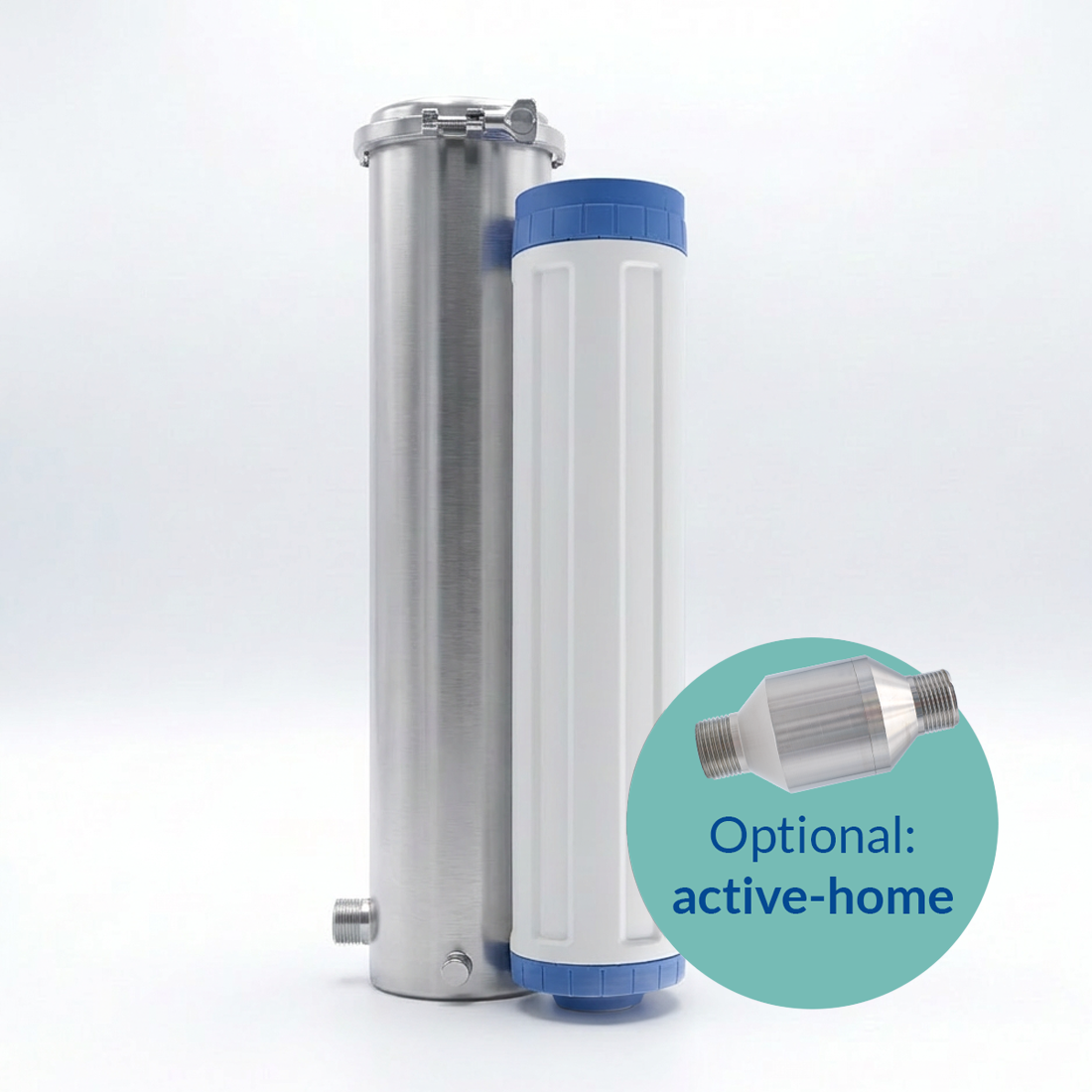
Learn moreA home water filter is a system installed at the building’s water inlet that treats the incoming tap water for the entire building. It protects plumbing, appliances, and fixtures and ensures a consistent baseline water quality all the way to the faucets.
More on home water filtersCalcium and magnesium content describes the amount of calcium and magnesium compounds in the water. It is directly related to water hardness and affects limescale buildup, household appliances, and, to some extent, taste.
Learn moreFood contact compliance means that materials, products, and processes that come into contact with food or drinking water meet legal, hygienic, and chemical requirements.
Learn moreTap water is treated water from the public water supply system that is distributed to individual households. It is subject to legal limits and is regularly tested.
Learn moreMineral content refers to the total amount of dissolved minerals in the water, such as calcium, magnesium, sodium, potassium, bicarbonate, sulfate, or chloride. It influences taste, water hardness, and technical properties.
Learn moreMineral water is natural water from a protected underground source. It is bottled close to the spring and has a characteristic composition of minerals and trace elements.
Learn moreReverse osmosis water is water that has been treated using a very fine membrane filtration process. This process significantly reduces the levels of many dissolved substances, salts, particles, and certain trace elements.
Learn moreThe pH value describes how acidic, neutral, or alkaline water is. It affects taste, corrosion behavior, limescale formation, and the chemical stability of the water.
Learn moreSpring water comes from a natural, underground spring and is bottled near the source. It is naturally pure and has a stable, though less strictly defined, composition than mineral water.
Learn moreRainwater treatment refers to the technical processing of collected rainwater so that it can be used as non-potable water. Typical applications include garden irrigation, toilet flushing, or cleaning.
Learn moreBottled water is artificially produced drinking water. It is usually made from tap water or treated water and may be enriched with minerals, salts, and carbonation.
Learn moreA bottled water production system is a technical system for producing bottled water. Treated water is cooled, carbonated, and, if necessary, remineralized to achieve a consistent flavor profile.
Learn moreDrinking water is water of a quality suitable for drinking, cooking, and food preparation. It must be microbiologically, chemically, and sensorially safe.
Learn moreA drinking water analysis is the professional testing of water samples for microbiological, chemical, physical, and sensory parameters. It determines whether water is suitable for drinking.
Learn moreDrinking water treatment encompasses all technical steps involved in converting raw water into drinking water that is hygienically, chemically, and sensory-wise flawless.
Learn moreA drinking water filter is a system that selectively removes unwanted substances immediately before use. The goal is consistent taste, reliable hygiene, and drinking-water-quality water straight from the tap.
View matching productsDrinking water quality describes the microbiological, chemical, physical, and sensory condition of water intended for human consumption.
Learn moreThe German Drinking Water Ordinance establishes requirements for the microbiological, chemical, physical, and sensory quality of drinking water and regulates monitoring, obligations, and measures to be taken in the event of deviations.
Learn moreSwiss regulations on drinking water quality define requirements for microbiology, chemistry, physics, and sensory properties, as well as the obligations of water suppliers and monitoring requirements.
Learn moreReverse osmosis is a membrane process in which water is forced under pressure through a very fine membrane. This process significantly reduces the concentration of many dissolved substances, salts, and certain trace elements.
Learn moreThe water distribution network transports drinking water from the water treatment plant to the house connection. The quality of the water at the tap then also depends on the home plumbing system, materials, stagnation, and maintenance.
Learn moreWater treatment involves technical processes that transform raw water into drinking water or process water that meets hygienic, chemical, and sensory standards.
Learn moreA water treatment system is a comprehensive technical solution for treating raw water or tap water so that it meets the desired hygienic, chemical, and sensory requirements.
Learn moreA water filter is a technical system that selectively removes undesirable substances from water. Depending on the system, these may include particles, bacteria, trace substances, and substances that affect taste and odor.
View suitable water filtersA water filtration system is a complete, multi-stage treatment unit designed to selectively reduce unwanted substances in water, ranging from particles and germs to trace substances.
Learn moreWater hardness describes the concentration of calcium and magnesium ions in water. It affects limescale buildup, detergent usage, and, to some extent, taste; however, it poses no health risks.
Learn more